Blogging

Sometimes the blogosphere is silly

Of course the blogosphere is silly. It is a reflection of our culture and others. There are uninformed and unthinking people everywhere. I read a bit today on an Review Journal article about the pet food contamination. In the article the importer responsible for importing the contaminated wheat gluten says "ChemNutra has sufficient insurance to pay for any judgments stemming from lawsuits filed by pet owners and others." A blogger commenting on this said they hoped the company didn't have enough insurance and would be forced out of business. Perhaps vengeance and the mob-mentality  make some feel  powerful and as though a wrong has been set right.  The comment, however, suggests that the pet owners who have already lost so much should now suffer the injustice of not even being compensated for their loss in any way.

Uncluttering with Google Analytics

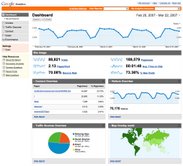
[Google Analytics Image] When I started developing websites, blogs and online tools more than I decade ago the value of log files hit me right away. Because these could be useful someday they have followed me around for some time. Google recently made some changes that enhanced their already great Google Analytics product.

There are without a doubt alternatives but each of these involves running and managing additional programs on the server. Another advantage is the way Google Analytics works with Google AdSense (see affiliate link below) which helps keep this site's hosting bill paid for. Along with the realization that the log files from sites that have been inactive for years aren't ever really going to be very useful. The sites that were online in 1995 to compete with them are just a different lot and there's little hat can't be better judged by a couple of weeks of Google Analytics to look at the sites.

Mob turns on Google

It seems the lynch mob after Google this morning over this result. It seems that if you search for "She Invented" in Google it returns "Did you mean He Invented?" at the top of the results. Of course with little research many are running off suggesting this is some kind of evil, anti-feminine plot. In reality it has far more to do with how Google spell check works. As that page points out when you search for "United Stats" it asks if you meant "United States". It isn't that "United Stats" has a mis-spelled word but rather that most people who search for "United Stats" modify their search to "United States". This brings up the question of how many searches one would have to do to game the system. Imagine what could be done with searches for "bad companies" and having "Did you mean our main competitor" pop up. Maybe that's the next step in search engine optimization/marketing -- blackhat version.

I'll be back

I will be returning here on a more regular basis next week. Plans were to try and do it today but DirecWay has a new Fair Access Policy and thinks I've used too much bandwidth while being gone the last week. Exciting updates to come when the technical problems are overcome.

Ten years of Scripting News

One week from today is the tenth anniversary of Dave Winer's blog, Scripting News. A post today says he has nothing special planned but to post ideas. Scripting News is one of the early blogs on the net. It pre-dates the term blog and its longer ancestor weblog. The groundbreaking way paved by Winer's Frontier software led to many things that today would be called blogs. One early project I started was RamLine which by today's standards would likely be considered a multi-author blog (and would be organized differently than it was).

Pseudo viral networks replace web rings

In the early days of the web and the start of the page rank notion links from other sites was the goal. Web rings sprang up like grass in spring and one could find a web ring for lopsided pine trees on the south side of the house. As this happened web users soon realized these networks weren't all that useful for finding information. At the same time the amount of information on the web was blossoming and users time became ever more scarce.

This is all a long way of starting to talk about what is happening here. The site purports to be building a listing of the "100 most prolific bloggers". The thing is the bar is set so very low (1000 posts) that most anybody who has blogged for any length of time would be in the list. Apparently no attention has been paid to the top bloggers. How many posts make up this blog? I'm not sure Dave Winer even knows but it is certainly one heck of a lot more than the 40,000 listed at the top of the aforementioned page.

The ultimate question is what does it matter? Is a prolific blogger somehow better than a non-prolific blogger? What does making more posts really represent? In many cases it represents a lot of pretty poor writing without anything of much interest being said. Most readers would rather have a few well written stories than volumes of the poorly researched and poorly written things that fill up some blogs when the goal is "how many times can I post today".

Back on the air

After a brief break to do some real world renovation I'll be back to writing a bit more frequently here. There are many things to cover from the George Strait concert last weekend to some great updates in web tools and the promised review of the Logitech Laser Desktop 530 (short version I love it, by the way). And with the SPAM module working pretty well comments won't be moderated anymore.

Drupal wish list

A couple of quickwish list items for Drupal.

  1. 5.x upgrade for the SPAM module. I've poked at it a little but so far haven't had time to really dig into it.
  2. Some awesome new themes. Garland is great but a few more will only help.
  3. An Atom module upgraded for 5.x
  4. A nice build script for automating the install. This is a bit trickier to do well and securely. I've got some code I'm playing with but I don't know that I'll release it becuase it presents the chance for abuse if people don't know what they're doing. If they do know what they're doing the shell scripts I've cobbled together may not be much help.

Recent Reads block for Drupal

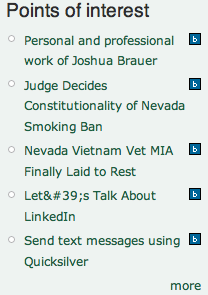
Linkblog pictureLinklogs or linkblogs give bloggers a way to share links with readers without feeling like a full post is necessary. Earlier this week there was a post over at Scripting News about the flexibility in the RSS spec to allow posts without titles. This flexibility is good as it allows for several different styles of blogging. I have shied away from one-sentence posts or shorter posts but still desire a way to let readers know about some interesting things that have crossed my path.

About a month ago I added the Recent Reads block on the left of this blog that is now called Points of Interest. The first version of the block was pretty straight forward. Using Drupal's aggregrator it is simple to point it towards the sharing feature of Google Reader. With that system in place once I came across an interesting post in my daily RSS reading I simply hit "Shift-S" and the next time the site updates the newest items are added to the recent reads block. This works great for things that come across in RSS but sometimes I would find things from emails or other sources that I wanted to include in the feed.

A couple of easy changes later Del.icio.us now feeds the Points of Interest block in addition to Google Reader. I simply setup a tag in Del.icio.us for each blog that I want a recent reads page on. This can be done in Google Reader as well. Instead of using the general "shared" feed it would be possible to hit the "t" key to tag a post and tag posts with the blog or blogs that I want the post to show up on. Maybe I'll do this later. To get the Drupal aggregrator to work as desired there are a couple of settings changes necessary. Now that the aggregrator is subscribed to both the Google Reader feed and Del.icio.us feed it is necessary to create a category, in this case called Recent Reads, which will be automatically assigned to every post in the feed.

Another great benefit is that because of Drupal's built in RSS capabilities the block is not only a point of interest on the blog page but readers can subscribe to it independently or in conjunction with the blog.
Subscribe to Blogging